Heat Shrink Packaging Machine: A Complete Guide for Manufacturers
Introduction: Why Are More Manufacturers Choosing Automatic Shrink Wrapping Machines?
Packaging is more than simply covering a product before shipment. It affects product presentation, handling efficiency, transportation, storage, and the overall production process.
For manufacturers handling bottled beverages, cartons, food products, cosmetics, household goods, and industrial products, manual packaging can become a bottleneck as production demand increases.
An automatic shrink wrapping machine provides an efficient solution by using heat-shrinkable film to wrap products or groups of products. After the film is sealed around the product, a heat-shrink tunnel applies controlled heat, causing the film to contract and form a tighter package.
Compared with repetitive manual wrapping, automatic shrink packaging equipment can help manufacturers reduce manual handling, improve packaging consistency, and connect packaging operations with existing production lines.
But how does a shrink wrapping machine work? Which shrink film should you choose? And what type of machine is suitable for your products?
This guide covers the working principles, machine types, packaging materials, applications, common packaging problems, and key purchasing considerations to help you make an informed decision.
What Is an Automatic Shrink Wrapping Machine?
An automatic shrink wrapping machine is industrial packaging equipment that uses heat-shrinkable film to wrap individual products or multiple products together.
The machine typically combines product conveying, film feeding, wrapping, sealing, and heat shrinking into one continuous packaging process.
When the wrapped product enters the shrink tunnel, controlled hot air heats the film and causes it to contract around the product.
The result is a neat package that can help keep products together, improve their appearance, and provide an additional layer of protection during handling and transportation.
How Does Heat Shrink Packaging Work?
Most automatic shrink packaging systems operate through two main stages:
Stage 1: Film Wrapping and Sealing
The product is positioned and wrapped with shrink film. A sealing mechanism joins or cuts the film according to the packaging format.
Stage 2: Heat Shrinking
The wrapped product passes through a heat-shrink tunnel. Hot air circulates around the product, causing the film to shrink and fit more closely around its shape.
The Complete Shrink Packaging Process
A typical automatic shrink packaging line follows this sequence:
Product feeding
Product positioning
Shrink film feeding
Film wrapping
Heat sealing and cutting
Heat shrinking
Finished product cooling
Product collection
The exact process depends on the machine type and packaging application. Some systems combine wrapping and sealing in one unit, while others use separate packaging and shrinking equipment.o.
Types of Automatic Shrink Wrapping Machines
Different products require different packaging methods. Choosing the correct machine type is important for achieving stable packaging quality and efficient production.
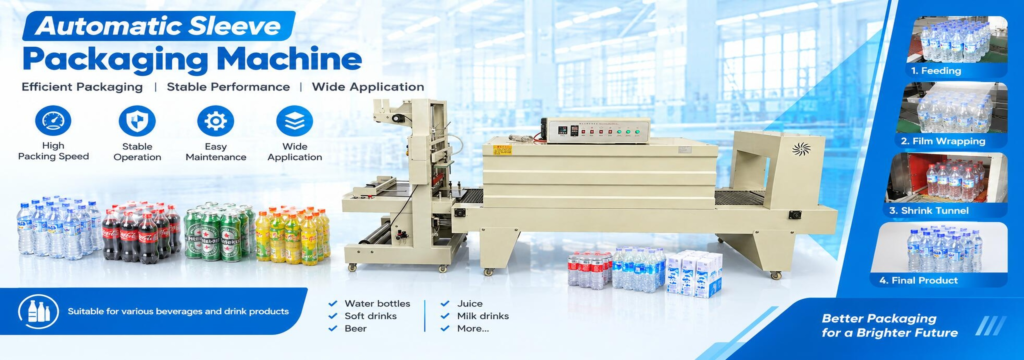
1. Sleeve Shrink Wrapping Machine
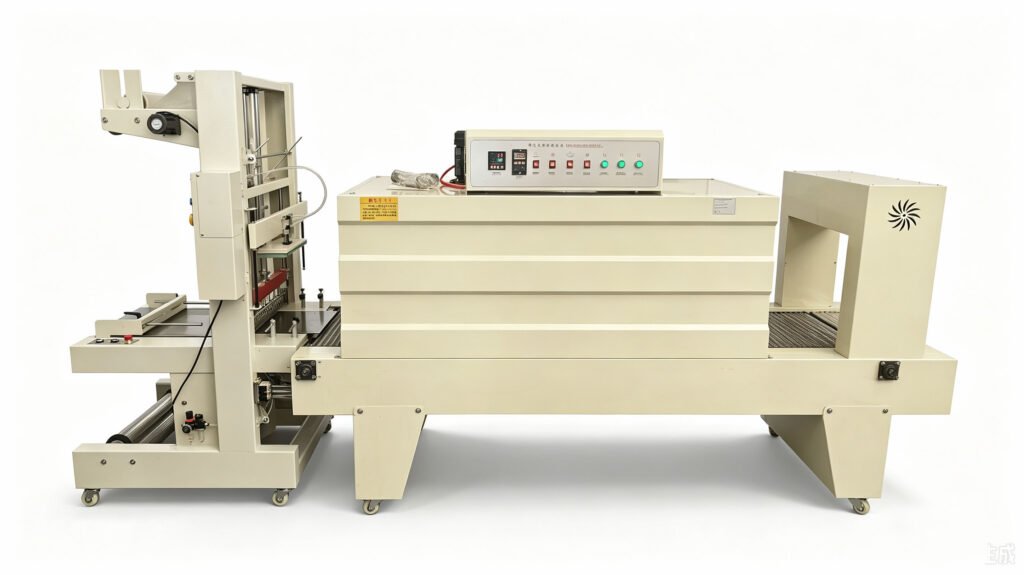
A sleeve shrink wrapping machine is designed to wrap individual products or groups of products with shrink film.
It is commonly used for bottled beverages, cartons, trays, plastic containers, and grouped products.
Typical applications include:
Bottled water multipacks
Soft drinks and juice bottles
Milk beverage bottles
Cartons and boxes
Tray-packed products
Household products
Industrial goods
A sleeve wrapper forms and seals the film around the product or product group. The wrapped product then enters a heat-shrink tunnel to complete the packaging process.
One advantage of sleeve shrink packaging is that multiple products can be grouped together without necessarily requiring an outer carton.
For example, bottled beverages can be arranged into different pack formats according to the manufacturer’s requirements.
Explore: [Automatic Sleeve Shrink Packaging Machine] — link to your sleeve packaging machine product page.
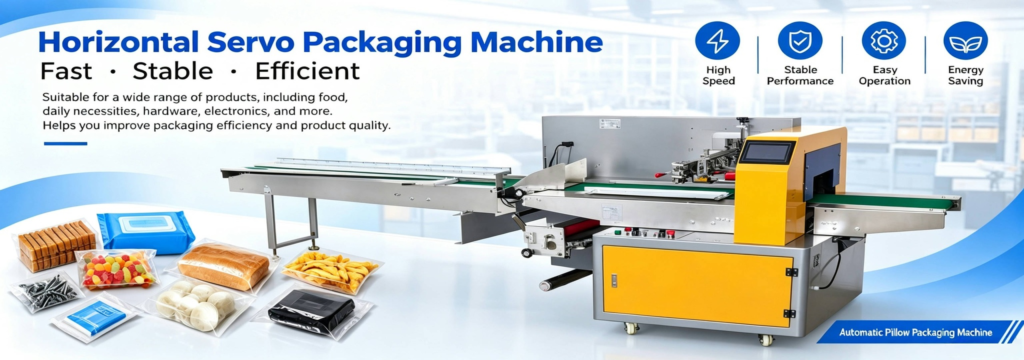
2. POF Shrink Wrapping Machine
A POF shrink wrapping machine uses polyolefin shrink film to package products that require a clear and professional appearance.
POF shrink film is commonly used for retail products, food packaging applications, cosmetics, stationery, toys, and consumer goods.
Typical applications include:
Bakery products
Biscuits and snacks
Cosmetic boxes
Gift boxes
Household products
Toys and stationery
Retail packages
POF film is known for its clarity and flexibility, making it suitable for applications where product visibility and package presentation are important.
Explore: [POF Servo Packaging Machine] — link to your POF packaging machine product page.
3. Side-Seal Shrink Wrapping Machine
A side-seal shrink wrapping machine is suitable for products with different lengths and dimensions.
The machine uses a continuous side-sealing process to wrap products with shrink film.
It is commonly considered for:
Long cartons
Books
Boxes
Cosmetic products
Household products
Irregular-shaped packages
Products with different lengths
Depending on the configuration, a side-seal system can support continuous packaging operations and different product dimensions.
4. L-Bar Shrink Wrapping Machine
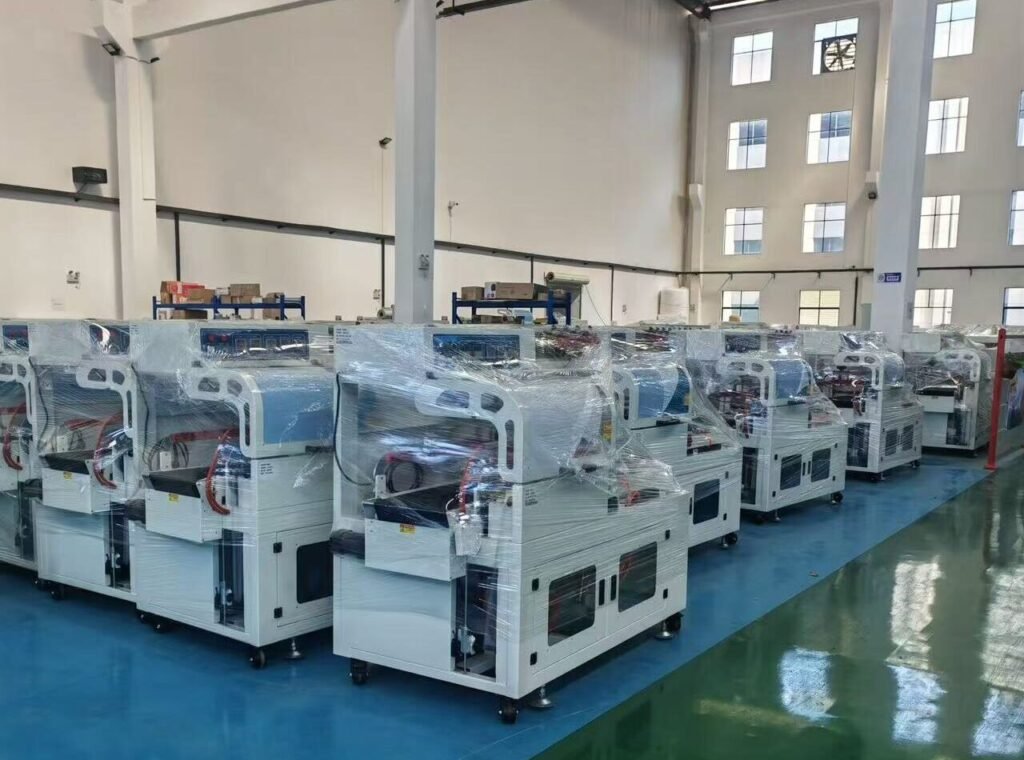
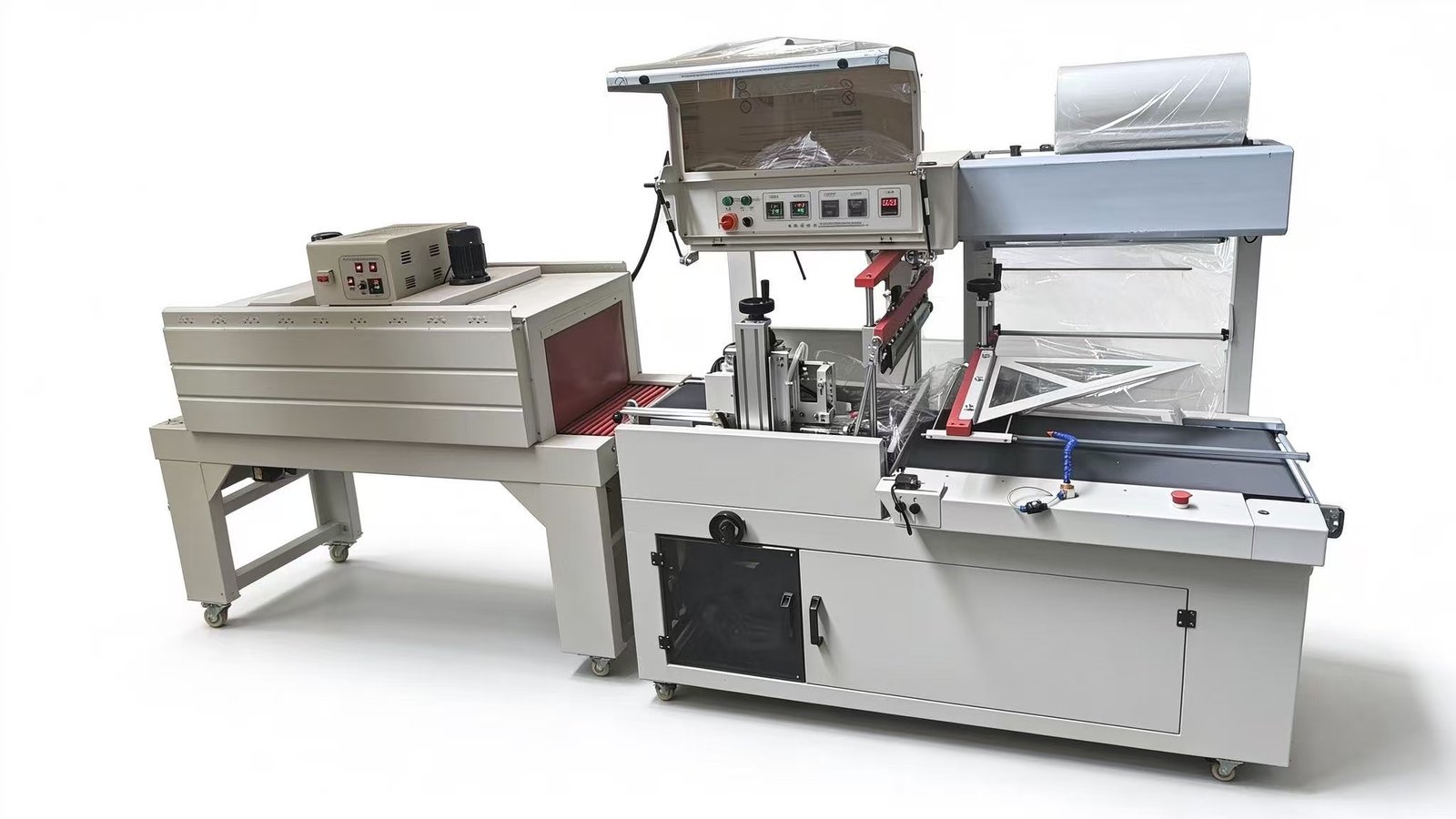
An L-bar shrink wrapping machine uses an L-shaped sealing bar to seal shrink film around products.
It is commonly used for smaller or medium-volume packaging operations and can be configured for manual, semi-automatic, or automatic production.
Typical applications include:
Small cartons
Retail products
Electronics
Cosmetics
Printed materials
Consumer goods
The appropriate configuration depends on production volume, product dimensions, and the required level of automation.
5. Heat Shrink Tunnel
A heat-shrink tunnel is an important component of many shrink packaging systems.
Its function is to apply controlled heat to the shrink film after the product has been wrapped and sealed.
The tunnel typically includes:
Heating elements
Air circulation system
Temperature control
Conveyor system
Insulated chamber
Adjustable operating parameters
A suitable heat-shrink tunnel helps produce a more consistent shrink effect across different products and packaging formats.
Important: A shrink tunnel does not replace the film-wrapping and sealing process. It works together with suitable upstream packaging equipment to complete the shrink packaging operation.
POF vs. PE Shrink Film: Which Material Is Better for Your Packaging Machine?
Choosing the right shrink film is just as important as choosing the machine.
Different film materials have different mechanical properties, shrink characteristics, clarity, thickness options, and packaging applications.
Two commonly used materials are POF and PE shrink film.
POF Shrink Film (Polyolefin)
POF shrink film is widely used for products that require transparent and attractive packaging.
Common characteristics include:
High transparency
Good product visibility
Flexible packaging performance
Suitable for many retail applications
Available in different thicknesses
Suitable for compatible automatic shrink packaging systems
Typical applications include food products, cosmetics, stationery, toys, and retail goods.
PE Shrink Film (Polyethylene)
PE shrink film is commonly used for bundling products and applications that require a stronger film structure.
Typical applications include:
Bottled water multipacks
Beverage bundles
Cartons
Industrial products
Heavy product groups
Tray and bundle packaging
PE shrink film is often selected for grouped packaging where package strength and product containment are important.
POF vs. PE Shrink Film Comparison
| Comparison | POF Shrink Film | PE Shrink Film |
|---|---|---|
| Full name | Polyolefin | Polyethylene |
| Appearance | Typically clear and glossy | Depends on film grade |
| Flexibility | Generally flexible | Depends on film formulation and thickness |
| Common applications | Retail products and individual packages | Multipacks and grouped products |
| Typical packaging | Cosmetics, food, toys, boxes | Bottles, cartons, industrial bundles |
| Machine requirements | Compatible POF shrink equipment | Compatible PE shrink equipment |
How Do You Choose the Right Shrink Film?
There is no single shrink film that is ideal for every product.
Before choosing a material, consider:
- Product dimensions and weight
- Required packaging strength
- Desired package appearance
- Film thickness
- Product arrangement
- Packaging speed
- Machine compatibility
- Transportation and storage conditions
The best approach is to test the film on the actual packaging machine using representative products.
Film specifications and recommended processing conditions should be confirmed with the film supplier.
What Products Can Be Packaged by an Industrial Shrink Wrapping Machine?
Shrink packaging is used across many industries because different machine configurations can accommodate a wide range of products.
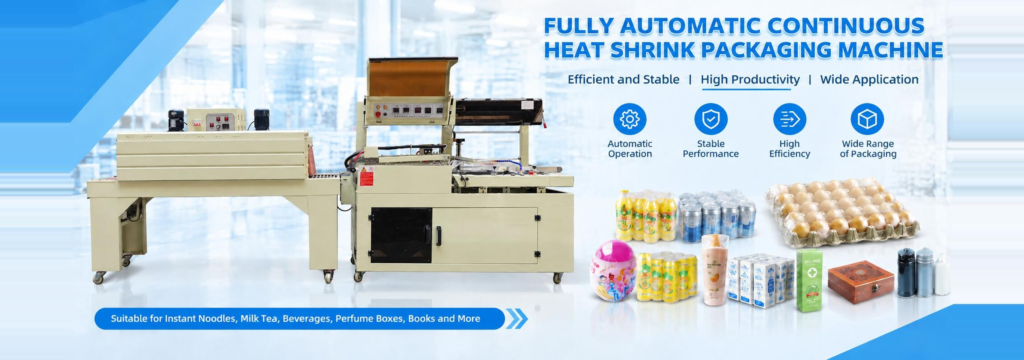
Food and Bakery Products
Shrink wrapping machines can be used for suitable food packaging applications, including:
Bread
Biscuits
Cookies
Cakes
Snacks
Food trays
Packaged food products
For food-contact applications, manufacturers should confirm that the selected film is suitable for the intended use and complies with applicable food-contact requirements.
Bottled Beverages
Beverage manufacturers frequently use shrink packaging to group products together.
Applications include:
Bottled water
Soft drinks
Juice
Milk beverages
Other bottled products
Sleeve shrink packaging can help group multiple bottles into convenient packages for storage, handling, and transportation.
Cosmetics and Personal Care Products
Shrink packaging is also used for:
Shampoo bottles
Cosmetic boxes
Skincare products
Personal care products
Perfume boxes
Household cleaning products
Transparent shrink film can provide a clean package appearance while helping keep products together.
Cartons, Boxes, and Industrial Products
Other applications include:
Product cartons
Gift boxes
Hardware
Building materials
Plastic containers
Industrial components
Consumer goods
For products with unusual shapes or dimensions, the conveyor, film system, and sealing mechanism may need to be customized.
Key Benefits of Automatic Shrink Packaging Equipment
1. Improve Packaging Efficiency
Automatic shrink packaging equipment integrates multiple packaging operations into a continuous process.
This can help manufacturers reduce repetitive manual work and improve the flow of products through the packaging area.
2. Reduce Manual Handling and Labor Requirements
Manual wrapping, sealing, and product grouping can require significant operator involvement.
Automation helps reduce repetitive handling and allows operators to focus on machine monitoring and other production tasks.
3. Achieve Consistent Packaging Quality
Machine-controlled film feeding, sealing, and shrinking help manufacturers maintain more consistent packaging results.
Correct machine settings and suitable film materials are important for achieving stable performance.
4. Improve Product Presentation
Shrink film can create a neat package around individual products or product groups.
For retail applications, transparent film can also allow customers to see the products inside.
5. Support Different Packaging Requirements
Depending on the machine configuration, shrink packaging equipment can handle different product sizes, shapes, and packaging arrangements.
Customized conveyors, guides, sealing systems, and tunnels can help accommodate specific production requirements.
6. Integrate With Existing Production Lines
Automatic shrink packaging equipment can be connected to upstream and downstream machinery.
For example:
Product Processing → Product Feeding → Shrink Packaging → Heat Shrinking → Cooling → Cartoning → Finished Product Collection
This helps manufacturers move toward a more coordinated production process.
Common Shrink Wrapping Problems and How to Improve Packaging Quality
Even with automatic equipment, incorrect film selection or machine settings can affect the finished package.
Understanding common problems helps operators identify possible causes and improve the packaging process.
Problem 1: Wrinkles or Uneven Shrink Film
Possible causes include:
Incorrect tunnel temperature
Uneven hot-air circulation
Unsuitable film dimensions
Incorrect conveyor speed
Improper product positioning
Possible solutions:
Check the film specifications, inspect air circulation, and adjust temperature and conveyor speed according to actual product testing.
Problem 2: Film Burning or Shrink Film Damage
Possible causes include:
Excessive tunnel temperature
Excessive heating time
Incorrect film selection
Insufficient distance between products and heating components
Possible solutions:
Check the film supplier’s recommended processing conditions and adjust the machine parameters gradually.
Problem 3: Weak or Incomplete Sealing
Possible causes include:
Incorrect sealing temperature
Insufficient sealing pressure
Damaged sealing components
Incorrect film material
Contamination around the sealing area
Possible solutions:
Inspect the sealing mechanism, check the film compatibility, and verify the sealing parameters.
Problem 4: Loose Packaging
Possible causes include:
Incorrect film size
Unsuitable film shrink characteristics
Inappropriate tunnel settings
Incorrect product arrangement
Possible solutions:
Review the film width and thickness, product positioning, tunnel temperature, and conveyor speed.
Problem 5: Inconsistent Packaging Results
When packaging quality changes between production runs, manufacturers should check:
Film batch consistency
Machine temperature stability
Conveyor speed
Product dimensions
Sealing condition
Air circulation
Machine maintenance
A systematic inspection of these factors can help identify the source of inconsistent packaging quality.
How to Choose the Right Automatic Shrink Wrapping Machine for Your Factory
Selecting a suitable shrink wrapping machine requires evaluating the product, packaging material, production capacity, and factory layout together.
1. Confirm Product Dimensions and Weight
Provide the supplier with:
Product length
Product width
Product height
Product weight
Product shape
Product photographs or videos
These details help determine the required conveyor width, sealing configuration, and machine dimensions.
2. Define Your Packaging Format
Explain how the finished product should look.
For example:
Individually shrink-wrapped products
Multiple bottles packed together
Cartons wrapped with shrink film
Tray-packed products
Irregular-shaped products
Products without an outer carton
The packaging format directly affects machine selection.
3. Select the Appropriate Film Material
Confirm whether your application requires POF, PE, or another compatible shrink film.
Film material, thickness, width, and shrink characteristics should be evaluated together with the packaging machine.
4. Determine Your Required Production Capacity
Provide your target output in packages per minute or packages per hour.
The actual production speed depends on:
Product dimensions
Product spacing
Feeding method
Packaging format
Film material
Sealing system
Shrink tunnel performance
Do not select a machine based only on its advertised maximum speed. Ask the manufacturer to evaluate your actual product and required packaging format.
5. Consider Factory Layout and Automation
For an existing production line, consider:
Conveyor direction
Conveyor height
Available installation space
Electrical supply
Upstream equipment
Downstream equipment
Operator access
Maintenance requirements
A machine that fits the production environment can be easier to install and operate.
6. Ask for a Product Packaging Test
Before confirming an order, provide actual product samples or representative product information.
A packaging test can help evaluate:
Film compatibility
Sealing quality
Shrink appearance
Product stability
Actual production speed
Finished package quality
This is one of the most practical ways to reduce uncertainty before purchasing equipment.
Why Choose Huixin for Automatic Shrink Packaging Solutions?
Huixin Intelligent Technology Co., Ltd. specializes in packaging machinery, food processing equipment, and industrial inspection solutions.
We provide packaging equipment for manufacturers and distributors with different production requirements.
Our product range includes:
- Other customized packaging and inspection equipment
Customized Equipment Configurations
Different products require different packaging configurations.
Our team can evaluate product dimensions, packaging formats, film materials, production capacity, and factory layout to help identify a suitable machine configuration.
Support Throughout the Purchasing Process
We provide support covering:
Pre-sales consultation
Equipment selection
Customized machine solutions
Production and quality inspection
Installation guidance
Technical training
Spare parts supply
After-sales technical support
From Individual Machines to Integrated Packaging Lines
Whether you need a standalone shrink wrapping machine or equipment connected to an existing production line, the solution should be designed around your actual manufacturing requirements.
Our goal is to help manufacturers improve packaging efficiency, reduce repetitive manual operations, and achieve more consistent packaging results.
Looking for an automatic shrink wrapping machine for your production line?
Contact Huixin Intelligent Technology and share your product photos, dimensions, packaging format, film material, and target production capacity.
Our team can help evaluate a suitable heat shrink packaging solution for your application.
Frequently Asked Questions About Shrink Wrapping Machines
Q1. What is an automatic shrink wrapping machine used for?
An automatic shrink wrapping machine uses heat-shrinkable film to wrap individual products or groups of products. It is commonly used for bottled beverages, cartons, food products, cosmetics, household goods, and industrial products.
Q2. How does a heat shrink packaging machine work?
The machine first wraps and seals shrink film around the product. The wrapped product then enters a heat-shrink tunnel, where controlled hot air causes the film to contract around the product.
Q3. What is the difference between POF and PE shrink film?
POF shrink film is commonly used for transparent retail packaging, cosmetics, food products, and consumer goods. PE shrink film is frequently used for grouped products, beverage multipacks, cartons, and applications requiring stronger film containment. The appropriate material depends on the product and packaging requirements.
Q4. Can a shrink wrapping machine package different product sizes?
Yes. Depending on the machine configuration, suitable equipment can accommodate different product dimensions. Adjustable guides, conveyors, and customized sealing systems may be required.
Q5. What is the function of a heat shrink tunnel?
A heat shrink tunnel applies controlled heat to shrink film around a product after the film has been wrapped and sealed. It helps create the final shrink-wrapped package.
Q6. Can shrink wrapping machines be integrated into an existing production line?
Yes. Automatic shrink packaging equipment can be connected with feeding conveyors, packaging machines, cooling conveyors, cartoning systems, and other production equipment. Integration depends on the factory layout and equipment specifications.
Q7. How do I choose the right shrink wrapping machine?
Consider product dimensions, weight, packaging format, film material, production capacity, available installation space, and automation requirements. Product testing is recommended before confirming the machine configuration.
Q8. What information should I provide to get a shrink wrapping machine quotation?
Prepare product photos or videos, product dimensions, product weight, packaging format, film material, required production speed, and factory power supply information. This helps the manufacturer evaluate a suitable machine and provide a more accurate quotation.
Final Recommendation
The right shrink wrapping machine should be selected according to your product, film material, packaging format, and production requirements. A properly configured packaging system can help improve efficiency and maintain consistent package quality.
Huixin Intelligent Technology — Your Partner for Automatic Packaging and Shrink Wrapping Solutions.