Automatic Bread Packaging Machine: How Horizontal Flow Wrapping Improves Bakery Packaging
Bread is one of the most widely produced and consumed food products worldwide. From sliced sandwich bread and hamburger buns to baguettes, toast, and specialty bakery products, manufacturers need packaging solutions that can handle different shapes and sizes while maintaining consistent packaging quality.
As bakery production grows, manual packaging can become a bottleneck. Workers may need to repeatedly place bread into bags, seal packages, and organize finished products. This process can increase labor requirements and make it difficult to maintain consistent packaging speed.
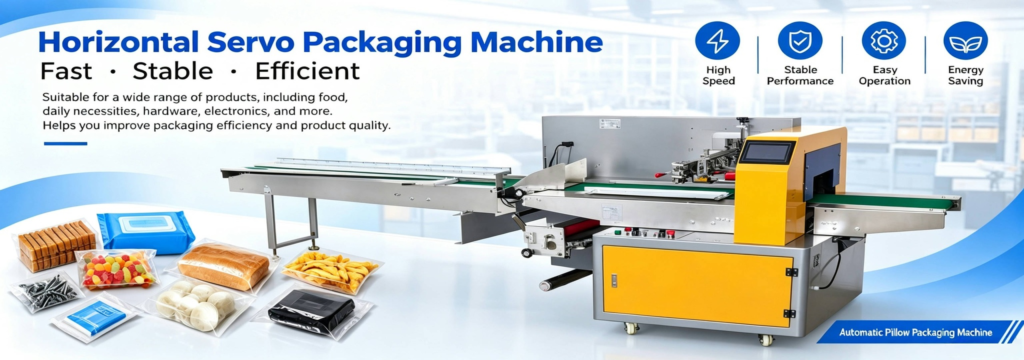
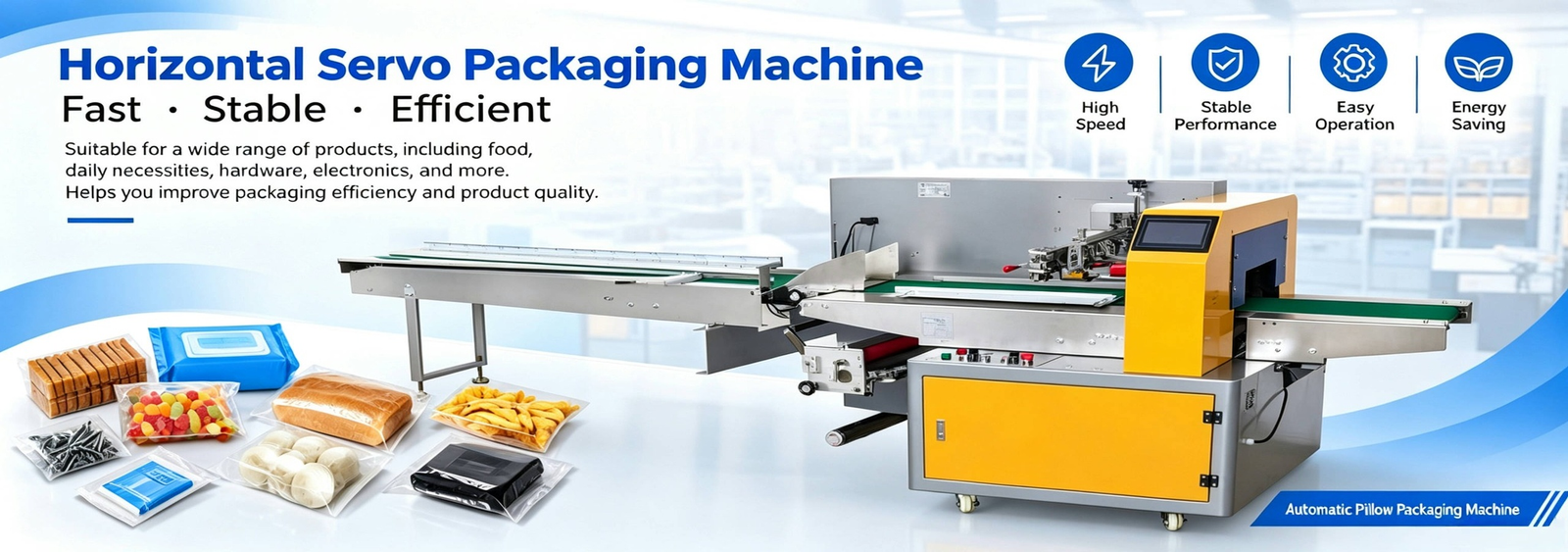
An automatic bread packaging machine offers a more efficient solution for modern bakeries. Using horizontal flow wrapping technology, manufacturers can automatically feed, wrap, seal, and cut packaging film around individual bread products.
For bakeries looking to improve production efficiency, reduce repetitive manual operations, and achieve professional packaging results, a horizontal flow wrapper can be an important part of an automated packaging line.
In this guide, we explain how horizontal bread packaging machines work, which bakery products they can handle, what packaging materials are available, and how to choose the right machine for your production requirements.
1. What Is an Automatic Bread Packaging Machine?
An automatic bread packaging machine is industrial packaging equipment designed to wrap bread and bakery products using flexible packaging film.
A commonly used solution is a horizontal flow wrapping machine, also known as a horizontal form-fill-seal (HFFS) machine.
During operation, bread products are transferred onto a conveyor and moved toward the packaging section. Packaging film is formed around each product, sealed along the package, and cut into individual packages.
The typical packaging process is:
Product Feeding → Product Positioning → Film Wrapping → Longitudinal Sealing → End Sealing and Cutting → Finished Package Output
Unlike manual bagging, an automatic flow wrapper performs these operations continuously according to preset machine parameters.
This makes it suitable for bakeries that need to package products consistently and efficiently.
What Types of Bread Can Be Packaged?
A horizontal flow wrapper can be configured for different bakery products, depending on product dimensions, shape, feeding conditions, and machine specifications.
Common applications include:
Sliced sandwich bread
Toast bread
Hamburger buns
Hot dog buns
Dinner rolls
Baguettes
Croissants
Bread rolls
Cakes and pastries
Other individually packaged bakery products
For products with different dimensions or irregular shapes, the feeding conveyor, product guides, film system, and sealing configuration may need to be adjusted.
2. How Does a Horizontal Flow Wrapper for Bread Work?
Understanding the working process helps bakery manufacturers determine whether a horizontal packaging machine is suitable for their production line.
Step 1: Automatic Bread Feeding
Bread products are transferred onto the machine’s infeed conveyor.
Depending on the production setup, products can be loaded manually or connected to an automatic feeding system.
Stable feeding is important because bread products need to enter the wrapping section at suitable intervals.
For soft products such as hamburger buns and sliced bread, the feeding arrangement should be designed to minimize unnecessary pressure and product deformation.
Step 2: Product Positioning and Conveying
The conveyor moves each bread product toward the film-forming section.
Product spacing and positioning help the machine create consistent package lengths and maintain stable sealing operations.
For bakeries producing different bread sizes, adjustable guides and suitable feeding configurations can help accommodate different product specifications.
Step 3: Automatic Film Wrapping
The packaging film is fed from a roll and formed around the bread product.
The machine wraps the film around the product to create a continuous tube before the sealing process.
The film material and width should be selected according to the bread dimensions, package design, and required packaging appearance.
Step 4: Sealing and Cutting
The machine performs longitudinal sealing and end sealing to form individual packages.
The sealing temperature, pressure, and timing should be adjusted according to the selected packaging material and machine configuration.
Proper sealing helps create a neat package and supports consistent packaging quality.
Step 5: Finished Bread Package Output
After sealing and cutting, individually wrapped bread products are transferred to the discharge conveyor.
Finished packages can then move to collection, inspection, cartoning, or other downstream operations.
The entire process can operate continuously, helping manufacturers reduce repetitive manual packaging work.
3. Why Do Bakeries Choose Automatic Bread Packaging Machines?
For commercial bakeries, packaging is not simply the final step of production. It affects labor requirements, product presentation, packaging consistency, and the overall production workflow.
An automatic bread packaging machine can offer several practical advantages.
3.1 Improve Bakery Packaging Efficiency
Manual bread packaging requires operators to repeatedly handle products and perform wrapping and sealing operations.
As production volume increases, these repetitive tasks may limit the output of the entire bakery line.
An automatic horizontal flow wrapper integrates product conveying, film wrapping, sealing, and cutting into one continuous process.
This helps bakeries improve packaging workflow and reduce manual handling.
3.2 Reduce Repetitive Labor Costs
Packaging bread manually can require multiple workers, particularly when the factory produces large quantities of bakery products.
Automation can reduce the amount of repetitive wrapping and sealing work performed by operators.
Workers can instead focus on product feeding, machine monitoring, packaging material preparation, and finished-product handling.
The actual labor savings depend on the existing production process and the level of automation.
3.3 Maintain Consistent Packaging Quality
Manual packaging may produce variations in package length, film positioning, and sealing appearance.
An automatic flow wrapping machine uses preset operating parameters to perform repeated packaging operations.
This helps manufacturers maintain more consistent package dimensions and sealing results.
3.4 Handle Different Bread Sizes and Shapes
Many commercial bakeries produce multiple product types.
For example, one production facility may manufacture sandwich bread, hamburger buns, baguettes, and small rolls.
A suitably configured horizontal bread packaging machine can accommodate different products within its supported size range.
Adjustable machine parameters and appropriate feeding configurations make product changeovers more manageable.
3.5 Improve Product Presentation
Transparent or printed packaging film can provide a clean and professional appearance.
Customers can identify the packaged product while manufacturers can use printed film to display branding, product information, and other required details.
The final appearance depends on film selection, package design, and machine settings.
4. Which Packaging Materials Are Suitable for Bread?
Choosing the right packaging film is important when selecting a bread packaging machine.
Different materials have different properties, including transparency, flexibility, sealing performance, and barrier characteristics.
Common film options for bakery packaging may include:
BOPP Film
Biaxially oriented polypropylene (BOPP) film is commonly used for bakery and snack packaging applications.
Potential advantages include:
Good transparency
Attractive product presentation
Good stiffness
Printability
Availability in different film structures
The appropriate film structure should be selected according to the product and packaging requirements.
CPP Film
Cast polypropylene (CPP) film can be used in flexible packaging structures and is valued for its sealing characteristics and flexibility.
It may be suitable for certain bread and bakery packaging applications when the film specification matches the machine and product requirements.
Laminated Packaging Film
Some bakery products require packaging films with additional barrier or mechanical properties.
Laminated structures can combine different materials to achieve the desired packaging performance.
The correct structure depends on the bread type, distribution conditions, desired shelf life, and packaging requirements.
How to Choose the Right Bread Packaging Film
Before selecting a film, manufacturers should consider:
Bread dimensions and weight
Product temperature during packaging
Required transparency
Film thickness
Sealing performance
Moisture and oxygen barrier requirements
Printing and branding requirements
Food-contact suitability
Food packaging materials should be suitable for their intended conditions of use. For information about food-contact materials, manufacturers can refer to the U.S. FDA Food Ingredients and Packaging guidance.
Important: The packaging machine itself does not automatically determine bread shelf life. Shelf life depends on the bread formulation, hygiene conditions, cooling process, packaging material, sealing quality, storage temperature, and other factors.
5. Important Considerations When Packaging Different Bread Products
Not all bakery products have the same packaging requirements.
A machine suitable for sliced sandwich bread may need different feeding or sealing adjustments when packaging soft buns or long baguettes.
Packaging Sliced Bread
Sliced bread is commonly packaged in bags or flexible film packages.
Important considerations include:
Consistent product dimensions
Stable product feeding
Package length
Film width
Sealing quality
Product alignment
The machine configuration should accommodate the bread’s dimensions and the desired package format.
Packaging Hamburger Buns and Soft Rolls
Hamburger buns and soft rolls can be easily deformed by excessive pressure.
The feeding system should therefore be designed to handle these products carefully.
What Should Manufacturers Pay Attention To?
Avoid excessive compression during feeding.
Maintain suitable spacing between products.
Select an appropriate package size.
Adjust conveyor and sealing parameters.
Test the actual product before finalizing the machine configuration.
Packaging Baguettes and Long Bread Products
Baguettes and other long bakery products may require a longer infeed arrangement and suitable film width.
The machine should be selected according to the maximum product length and cross-sectional dimensions.
Customized guides or conveyor arrangements may be required for specific product shapes.
Packaging Freshly Baked Bread
Freshly baked bread should be handled according to the bakery’s established cooling and packaging process.
In many production lines, bread is allowed to cool before packaging to reduce the risk of trapped heat and condensation inside the package.
The appropriate cooling conditions depend on the bread recipe, product size, production environment, and packaging material.
6. Manual Bread Packaging vs. Automatic Flow Wrapping
As bakery production increases, manufacturers may need to evaluate whether manual packaging can still meet their output requirements.
| Comparison | Manual Packaging | Automatic Horizontal Flow Wrapping |
|---|---|---|
| Product handling | Mainly manual | Conveyor-based |
| Film wrapping | Manual | Automatic |
| Sealing | Manual or semi-automatic | Integrated machine process |
| Packaging consistency | Operator dependent | Controlled by machine parameters |
| Labor requirements | Higher for repetitive tasks | Reduced repetitive work |
| Continuous operation | Limited by manual handling | Designed for continuous packaging |
| Product changeover | Manual adjustment | Parameter and mechanical adjustment |
| Production-line integration | Limited | Can connect with other equipment |
Manual packaging may remain suitable for small bakeries with low production volumes.
For commercial bakeries with higher output requirements, automatic flow wrapping can provide a more efficient and consistent packaging process.
7. How to Choose the Right Horizontal Bread Packaging Machine
Choosing a bread packaging machine should begin with the actual product and production requirements rather than machine speed alone.
7.1 Product Dimensions and Weight
Provide the manufacturer with the maximum and minimum product dimensions.
Important measurements include:
Product length
Product width
Product height
Product weight
Product shape
These details help determine the appropriate conveyor width, film size, and sealing configuration.
7.2 Required Production Capacity
Consider how many products your bakery needs to package per minute or per hour.
The actual packaging output depends on:
Product size
Product spacing
Feeding method
Packaging length
Film characteristics
Machine configuration
A machine’s maximum advertised speed should not be treated as guaranteed output for every bread product.
7.3 Packaging Film Requirements
Tell the supplier which film material you plan to use.
Different films may require different sealing temperatures and machine settings.
It is recommended to test the actual film before purchasing equipment.
7.4 Bread Feeding Method
Consider whether products will be fed manually, by a conveyor, or through an automatic feeding system.
For factories producing several bread types, the feeding arrangement can have a significant effect on overall production efficiency.
7.5 Factory Layout and Production-Line Integration
The machine should fit the available factory space and connect properly with upstream and downstream equipment.
For example, a bakery production line may include:
Bread Cooling → Product Feeding → Horizontal Packaging → Weight Inspection → Metal Detection → Cartoning → Finished Product Collection
The exact sequence depends on the factory’s process and quality-control requirements.
8. Can a Bread Packaging Machine Be Integrated With Other Equipment?
Yes. A horizontal flow wrapper can be used as an individual machine or integrated into a larger bakery production line.
For manufacturers planning to improve automation, the packaging process can be connected with:
Automatic product feeding systems
Cooling conveyors
Checkweighers
Food metal detectors
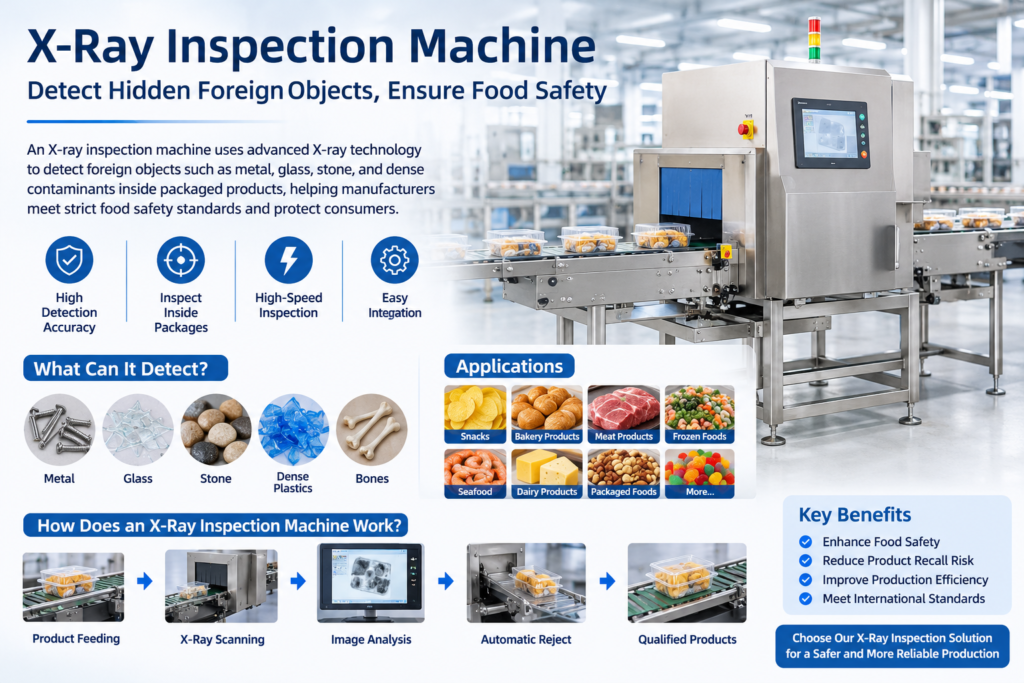
X-ray inspection machines
Cartoning equipment
Finished-product conveyors
Why Integrate Packaging and Inspection?
For commercial bakeries, packaging and inspection often serve different purposes.
A horizontal packaging machine wraps the bread product, while a checkweigher checks product weight and a food metal detector helps identify metal contamination.
An X-ray inspection system can provide additional inspection capabilities for certain foreign objects, depending on the product and system configuration.
Connecting suitable equipment can help manufacturers create a more organized production and quality-control workflow.
9. Huixin Horizontal Bread Packaging Machine Solutions
Huixin Intelligent Technology Co., Ltd. provides automatic packaging machinery and food inspection equipment for manufacturers in the food processing and packaging industries.
Our horizontal packaging solutions are designed for different product dimensions, packaging materials, and production requirements.
Depending on the application, machine configurations can include:
Automatic product conveying
Horizontal film feeding
Automatic film wrapping
Longitudinal sealing
End sealing and cutting
Adjustable packaging parameters
Customized conveyor arrangements
Integration with existing production lines
Our equipment can be evaluated for applications involving sliced bread, hamburger buns, rolls, baguettes, biscuits, snacks, vegetables, and other suitable products.
We also provide other industrial equipment, including:
From equipment selection to customized machine configuration, installation guidance, operator training, spare parts, and technical support, our team aims to help customers establish more efficient packaging processes.
Conclusion: Improve Bakery Production With an Automatic Bread Packaging Machine
For modern bakeries, packaging efficiency is an important part of overall production performance.
An automatic bread packaging machine using horizontal flow wrapping technology can help manufacturers automate product feeding, film wrapping, sealing, and cutting.
By selecting the right machine configuration, bakery manufacturers can reduce repetitive manual operations, improve packaging consistency, and accommodate different bread products within the machine’s supported range.
However, the right solution depends on product dimensions, bread characteristics, packaging film, required production capacity, and factory layout.
Looking for an automatic bread packaging machine for your bakery?
Contact Huixin Intelligent Technology and share your bread photos, product dimensions, packaging film requirements, and target production capacity.
Our team can help evaluate a suitable horizontal flow wrapping solution for your bakery production line.
Frequently Asked Questions About Automatic Bread Packaging Machines
Q1. What is the best machine for packaging bread automatically?
A horizontal flow wrapping machine is a commonly used solution for automatically packaging individual bread products. The suitable model depends on bread dimensions, product characteristics, packaging film, and required output.
Q2. Can a horizontal flow wrapper package different types of bread?
Yes. Depending on its configuration and supported size range, a horizontal flow wrapper can package sliced bread, hamburger buns, rolls, baguettes, and other bakery products.
Q3. What packaging film is commonly used for bread?
BOPP, CPP, and suitable laminated flexible packaging films may be used for bread packaging. The correct film depends on sealing requirements, product characteristics, desired barrier properties, and machine compatibility.
Q4. Can the machine package soft hamburger buns without deforming them?
A suitable feeding and conveying configuration can help minimize product compression. Actual performance should be verified through testing with the customer’s bread products.
Q5. Can one bread packaging machine handle different product sizes?
Some machines support multiple product sizes through parameter adjustments and suitable mechanical changes. The maximum and minimum product dimensions should be confirmed with the manufacturer before purchasing.
Q6. Does an automatic bread packaging machine increase bread shelf life?
Not by itself. Shelf life depends on the bread formulation, hygiene, cooling process, packaging material, sealing quality, storage conditions, and other factors. Packaging equipment helps create the package but does not independently guarantee a longer shelf life.
Q7. Can a horizontal bread packaging machine connect to an existing bakery production line?
Yes. It can be configured to connect with suitable feeding conveyors, cooling systems, inspection equipment, and downstream packaging equipment. Factory layout and conveyor specifications should be evaluated before integration.
Q8. What information should I provide when requesting a bread packaging machine quotation?
Prepare product photos or videos, product length, width and height, product weight, packaging film type, target production capacity, and factory power supply information. These details help the manufacturer recommend a suitable machine configuration.