Food safety is one of the most important concerns for modern food manufacturers. During food processing, handling, and packaging, foreign objects may accidentally enter products through raw materials, processing equipment, packaging materials, or other production activities.
Some contaminants, such as metal fragments, glass pieces, stones, and dense materials, may be difficult to identify through visual inspection alone.
Even with strict production procedures, foreign object contamination remains a risk that food manufacturers need to manage.
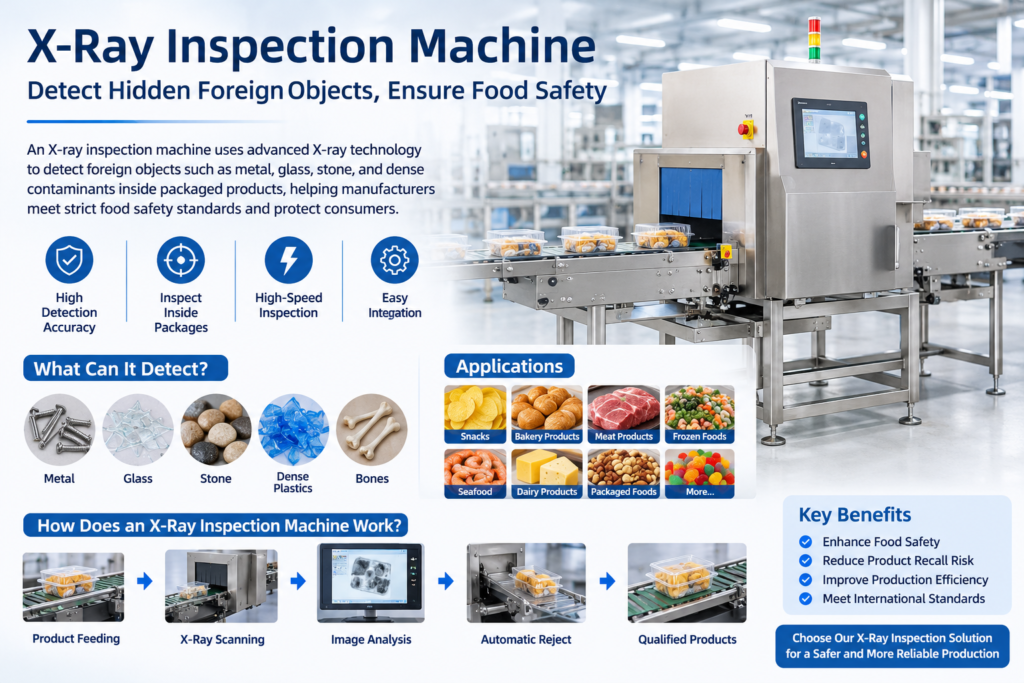
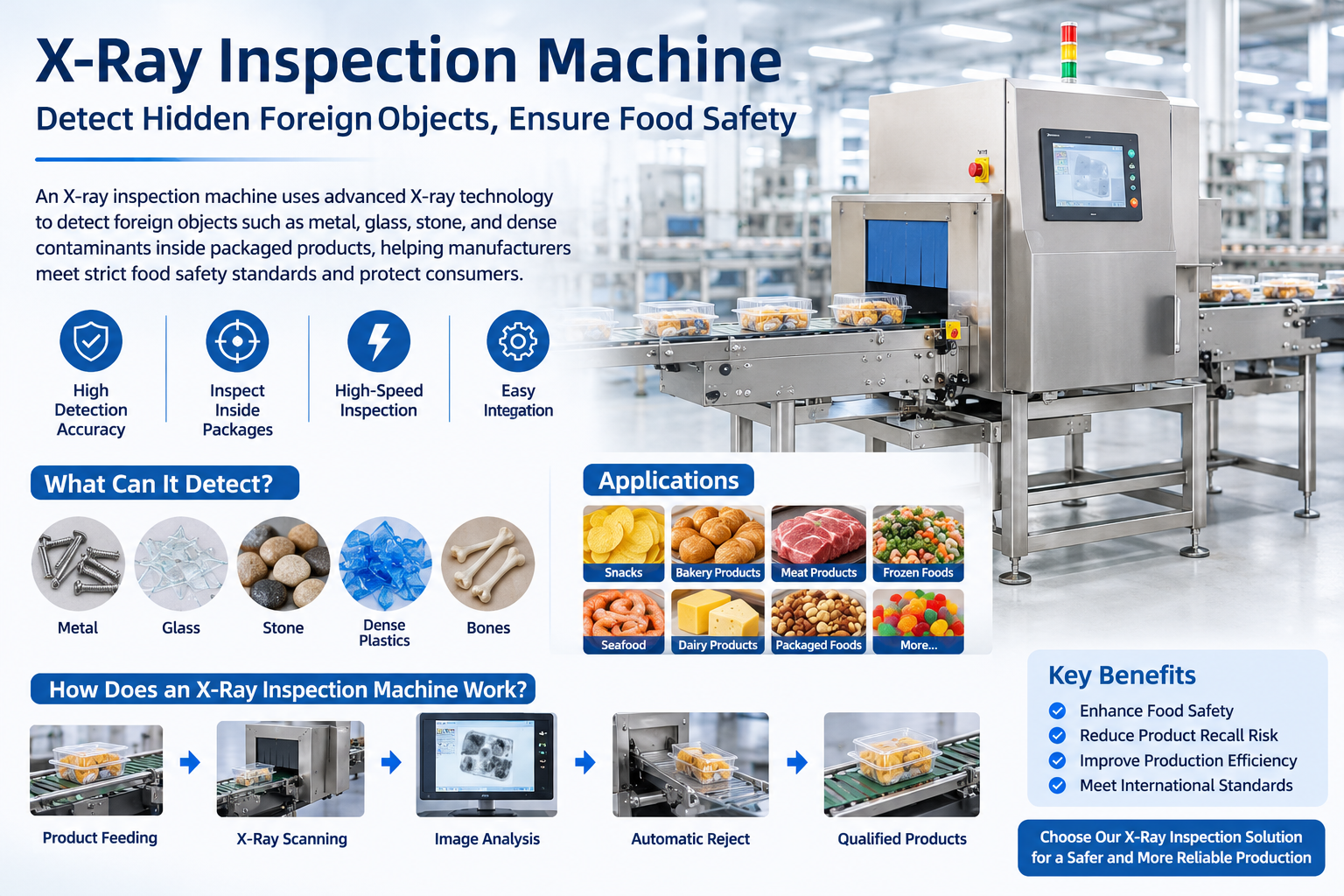
An X-ray inspection machine provides an advanced inspection solution by using X-ray technology to examine products and identify foreign objects based on differences in density and X-ray absorption.
Unlike conventional visual inspection, an X-ray system can inspect products inside sealed packages, helping manufacturers strengthen quality control before products reach consumers.
In this guide, we will explain how food X-ray inspection machines work, what they can detect, their applications, and what manufacturers should consider when choosing an inspection system.
1. What Is an X-Ray Inspection Machine?
An X-ray inspection machine is an industrial inspection system that uses X-ray technology to examine products and identify certain foreign objects or product abnormalities.
In the food industry, these systems are commonly installed on production lines to inspect packaged or unpackaged food products.
During inspection, products pass through an X-ray scanning area. The system generates X-ray images and analyzes differences in material density and absorption.
Foreign objects with different X-ray absorption characteristics from the surrounding product can appear as distinguishable features in the inspection image.
Depending on the system configuration and software capabilities, an X-ray inspection machine can help detect contaminants such as:
*Metal fragments
*Glass pieces
*Stones
*Certain mineral materials
*Calcified bones
*Certain dense plastics
*Other foreign materials with sufficient density contrast
Detection performance depends on the contaminant’s size, density, shape, orientation, product characteristics, and machine configuration.
For this reason, product testing is important when selecting an X-ray inspection solution.
2. How Does an X-Ray Inspection Machine Work?
An industrial X-ray inspection system typically combines an X-ray generator, detector, conveyor system, image-processing software, and control system.
The general inspection process includes five stages.
Step 1: Product Feeding
Products are transferred onto the inspection conveyor.
Depending on the application, the machine can inspect individual products, bags, boxes, trays, bottles, or other packaged items.
Stable product spacing and positioning help maintain consistent inspection conditions.
Step 2: X-Ray Scanning
Products pass through the shielded inspection chamber.
The X-ray generator produces X-rays that pass through the product and reach the detector.
Different materials absorb X-rays at different levels depending on their composition, density, thickness, and other physical characteristics.
Step 3: Image Processing and Analysis
The detector converts the received X-ray signals into an image.
The inspection software analyzes the image to identify potential foreign objects or other configured inspection conditions.
The system compares detected image features with preset inspection parameters.
Step 4: Automatic Rejection
When a product is identified as defective or contaminated, the system can activate an automatic rejection mechanism, depending on the machine configuration.
Common rejection options may include:
*Air-blow rejection
*Pusher rejection
*Drop-down rejection
*Belt separation
*Other customized rejection mechanisms
The appropriate method depends on product weight, dimensions, packaging type, and production speed.
Step 5: Qualified Product Output
Products that pass inspection continue to the next production stage.
Rejected products are separated for further investigation and handling.
This creates a continuous inspection process that can be integrated into automated production lines.
3. What Foreign Objects Can an X-Ray Inspection Machine Detect?
One of the major advantages of X-ray inspection technology is its ability to detect certain non-metallic foreign objects that conventional metal detection systems cannot identify.
Metal Fragments;
Metal fragments may enter food products through equipment wear, damaged machine components, or raw materials.
X-ray inspection can identify many metal contaminants, depending on their size, composition, and position within the product.
Glass;
Glass fragments are a potential contamination risk in food processing and packaging environments.
X-ray inspection can help identify glass pieces when there is sufficient density contrast between the glass and the surrounding product.
Stones and Mineral Materials;
Stones and other dense mineral contaminants may enter food products through agricultural raw materials or processing operations.
An X-ray inspection system can help detect these materials when their density and size provide sufficient contrast.
Calcified Bones;
For certain meat and poultry applications, X-ray inspection can help identify calcified bone fragments.
Detection performance depends on the product structure, bone characteristics, product thickness, and system configuration.
Certain Dense Plastics and Rubber;
Some high-density plastics and rubber materials may also be detectable.
However, not all plastic or rubber contaminants can be reliably detected by X-ray systems. Their composition, density, dimensions, and contrast against the product are important factors.
Important: No single inspection technology can guarantee detection of every possible foreign object. Actual performance should be verified through testing with representative products and contaminant samples.
4. What Food Products Can Be Inspected?
Food X-ray inspection machines are suitable for various food production applications.
The machine configuration should be selected according to product characteristics, packaging format, production speed, and inspection requirements.
Snacks and Bakery Products
Typical applications include:
*Potato chips
*Biscuits
*Cookies
*Bread
*Cakes
*Crackers
*Packaged snacks
X-ray inspection can help identify certain dense foreign objects inside packaged bakery and snack products.
Meat and Poultry Products;
Meat and poultry processing may involve raw materials, cutting, deboning, and other operations where foreign object control is important.
X-ray inspection can be used to help identify metal fragments, certain bone fragments, and other detectable contaminants.
Seafood Products
Typical applications include:
*Frozen fish
*Shrimp
*Fish fillets
*Seafood packages
*Processed seafood products
Inspection parameters should be adjusted according to product thickness, moisture content, temperature, and packaging conditions.
Frozen Foods
X-ray inspection can be used for various frozen food products, including:
*Frozen vegetables
*Frozen meat
*Frozen seafood
*Frozen prepared meals
*Other packaged frozen products
*Dairy and Packaged Foods
Applications may include:
*Cheese
*Dairy products
*Ready-to-eat meals
*Canned or packaged foods
*Other processed food products
The actual inspection suitability should be confirmed through product testing.
5. Why Do Food Manufacturers Need X-Ray Inspection?
Installing an X-ray inspection system can provide several advantages for food manufacturers.
1. Detect Certain Non-Metallic Contaminants
Traditional metal detectors primarily focus on detecting metal contamination.
X-ray inspection technology can help identify certain non-metallic foreign objects, such as glass, stones, and calcified bones, depending on their density and the product being inspected.
This provides an additional inspection method for food manufacturers.
2. Inspect Products Inside Sealed Packages
One important advantage of X-ray inspection is that products can be inspected after packaging.
The system can examine products through many types of packaging materials, including certain sealed bags, trays, cartons, and other packaging formats.
This is particularly useful for manufacturers who want to inspect finished products before shipment.
However, package structure, product thickness, and material composition can influence inspection performance.
3. Support Automated Production
An X-ray inspection machine can be integrated into an existing conveyor system.
With an automatic rejection mechanism, products that fail inspection can be separated without requiring operators to manually inspect every item.
This helps manufacturers build a more automated quality-control process.
4. Improve Product Quality Control
X-ray inspection adds another inspection point to the production process.
It can help manufacturers identify potential contamination issues and collect inspection information for quality management.
5. Help Reduce Product Recall Risks
Foreign object contamination can lead to customer complaints, product returns, recalls, and damage to brand reputation.
An appropriately selected and maintained X-ray inspection system can help manufacturers strengthen their foreign object control procedures.
It should be used as part of a broader food safety management system rather than as a replacement for preventive controls.
6. What Should You Consider When Choosing an X-Ray Inspection Machine?
Selecting an industrial X-ray inspection machine requires more than comparing equipment prices.
Manufacturers should evaluate the following factors before purchasing.
Product Type and Characteristics
Different products create different inspection conditions.
Provide the supplier with information about:
*Product category
*Product dimensions
*Product weight
*Product thickness
*Product density
*Product temperature
*Product moisture
*Product structure
*Packaging Material
The packaging material may influence the X-ray image and inspection performance.
Common packaging formats include:
*Plastic bags
*Vacuum packages
*Plastic trays
*Cartons
*Bottles
Other sealed packages;
Metalized packaging and certain dense packaging materials require particular attention during product testing.
Required Detection Performance;
The required inspection sensitivity should be determined according to the target contaminants, product characteristics, applicable standards, and production requirements.
Rather than relying only on advertised sensitivity figures, manufacturers should request testing using representative product samples and contaminant standards.
Production Speed
The machine should match the required production capacity.
Important factors include:
*Products per minute
*Conveyor speed
*Product spacing
*Product dimensions
*Rejection response time
Actual inspection speed should be verified using the customer’s real products.
Automatic Rejection System;
Different products require different rejection methods.
Lightweight packaged products may use an air-blow system, while heavier or larger products may require a pusher or other mechanical separation method.
The rejection system should be selected to avoid disturbing nearby qualified products.
Hygiene and Cleaning Requirements;
Food processing equipment should be designed according to the factory’s hygiene and cleaning requirements.
Manufacturers should consider the machine’s structure, contact materials, accessibility, and cleaning procedures.
Radiation Safety;
Industrial X-ray inspection equipment should incorporate appropriate shielding and safety interlocks.
Installation, operation, maintenance, and radiation safety controls must follow applicable local regulations and the equipment manufacturer’s instructions.
7. Integrating X-Ray Inspection Into a Food Production Line
An X-ray inspection machine can operate as a standalone unit or as part of a larger automated inspection system.
A typical food production line may include:
Raw Material Processing → Product Preparation → Packaging → X-Ray Inspection → Automatic Rejection → Checkweighing → Cartoning → Finished Product Storage
The actual process varies by industry and factory requirements.
For example, an X-ray inspection machine can be installed after packaging to inspect finished products before they enter storage or distribution.
It can also be combined with food metal detectors and automatic checkweighers to provide different types of inspection.
Metal Detection: Focuses on metal contamination.
X-Ray Inspection: Helps detect certain dense foreign objects and may support additional image-based inspection functions.
Checkweighing: Checks product weight and identifies underweight or overweight products.
Combining suitable inspection technologies can help manufacturers develop a more comprehensive quality-control process.
8. Huixin X-Ray Inspection Solutions
Huixin Intelligent Technology Co., Ltd. provides food inspection equipment and packaging machinery for manufacturers seeking to improve production automation and product quality control.
Our product range includes:
*Industrial X-ray inspection machines
*Food metal detectors
*Dynamic checkweighers
*Automatic packaging machines
*Customized production-line equipment
We understand that different products and production environments require different inspection configurations.
When evaluating an X-ray inspection solution, our team can assist with:
*Product application evaluation
*Machine selection
*Inspection configuration
*Product sample testing
*Production-line integration
*Installation guidance
*Operator training
Spare parts and technical support
Whether you manufacture snacks, meat products, seafood, bakery products, frozen foods, or other packaged products, selecting the appropriate inspection equipment is an important step toward strengthening product quality control.
Our goal is to help manufacturers build more reliable and efficient production and inspection processes.
Conclusion
An X-ray inspection machine is an important inspection solution for modern food manufacturing.
By using X-ray imaging technology, it can help identify certain foreign objects inside products, including metal fragments, glass, stones, calcified bones, and certain dense plastics.
Compared with conventional metal detection, X-ray inspection offers additional inspection capabilities for certain non-metallic contaminants and can inspect products through many types of packaging.
However, actual detection performance depends on product characteristics, contaminant properties, packaging materials, machine configuration, and operating conditions.
For manufacturers planning to upgrade their food inspection process, the best starting point is to evaluate actual products and target contaminants before selecting equipment.
Looking for an X-ray inspection machine for your food production line?
Contact Huixin Intelligent Technology and share your product photos, dimensions, packaging format, and inspection requirements. Our team can help evaluate a suitable X-ray inspection solution for your application.
Frequently Asked Questions (FAQ)
Q1: What is an X-ray inspection machine used for in the food industry?
It is used to inspect food products for certain foreign objects and other configured product abnormalities. It uses X-ray imaging to identify differences in material density and absorption.
Q2: What foreign objects can an X-ray inspection machine detect?
Depending on the product and machine configuration, it can detect metal fragments, glass, stones, calcified bones, and certain dense plastics or rubber materials.
Q3: Can an X-ray machine detect glass in food?
Yes. X-ray inspection can detect certain glass contaminants when sufficient density contrast exists between the glass and the surrounding food product.
Q4: Can an X-ray inspection machine detect plastic?
It can detect certain high-density plastics, but not all plastic materials. Detection depends on the plastic composition, density, size, shape, and surrounding product.
Q5: Can X-ray inspection detect foreign objects inside sealed packages?
Yes. X-ray inspection can examine products through many packaging materials, including plastic bags, trays, and cartons. Actual performance depends on packaging composition and product characteristics.
Q6: What is the difference between an X-ray inspection machine and a metal detector?
A metal detector primarily identifies metal contaminants using electromagnetic technology. An X-ray inspection machine uses X-ray imaging and can identify certain non-metallic contaminants as well as metal objects.
Q7: Is an industrial X-ray inspection machine safe for food production?
Industrial food X-ray inspection machines are designed with shielding and safety controls. They must be installed, operated, and maintained according to the manufacturer’s instructions and applicable radiation safety regulations.
Q8: How do I choose the right X-ray inspection machine?
Consider your product dimensions, weight, packaging material, production speed, target contaminants, required inspection performance, and rejection method. Testing representative product samples is recommended before purchasing.