Food manufacturers face many challenges during production.
Raw materials may contain foreign materials, while equipment components can potentially wear during long-term operation. Metal contamination can also occur unexpectedly during processing, conveying, cutting, mixing, or packaging.
Because metal fragments may not be visible to the naked eye, visual inspection alone cannot provide sufficient protection.
This is why metal detection has become an important part of many modern food production and quality-control systems.
Where Can Metal Contamination Come From?
Metal contamination can have different sources.
Possible sources include:
- Equipment wear
- Broken machine components
- Metal fragments from maintenance
- Raw materials
- Processing equipment
- Cutting and grinding operations
- Production-line components
Even with strict production procedures, contamination risks cannot always be completely eliminated.
The purpose of a food metal detector is therefore not to replace good manufacturing practices, but to provide an additional inspection barrier.
How Does a Food Metal Detector Work?
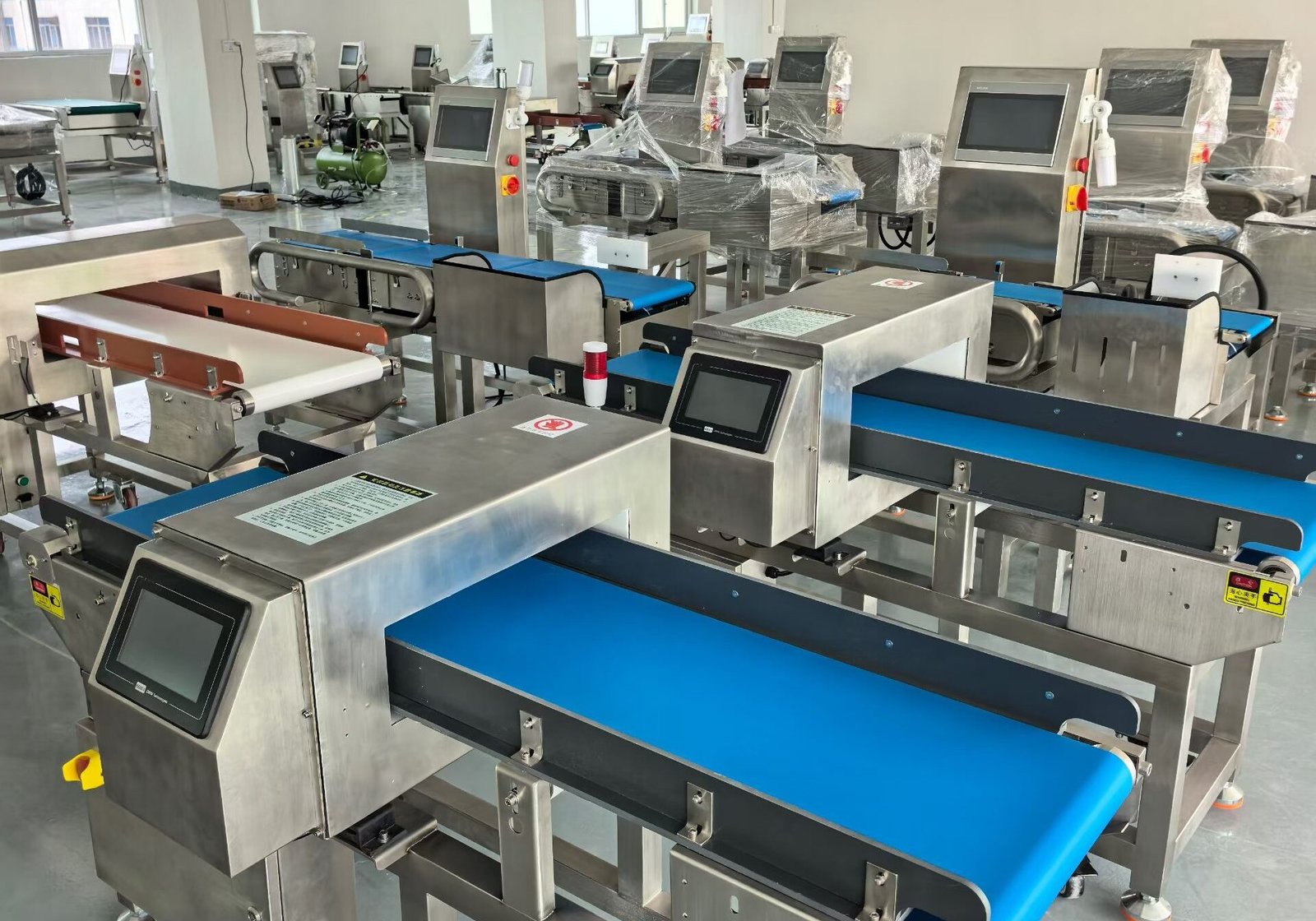
A typical conveyor-type food metal detector uses a detection system to identify metal contamination as products pass through the inspection area.
When a contaminated product is detected, the system can activate a rejection mechanism to remove the product from the production line.
The general process is:
Product Feeding → Metal Detection → Signal Processing → Automatic Rejection → Qualified Product Continues
This allows manufacturers to inspect products continuously during production.
What Types of Products Can Be Inspected?
Food metal detectors can be used in many food-processing applications.
Typical applications include:
- Snacks
- Bakery products
- Meat products
- Seafood
- Frozen foods
- Flour
- Spices
- Seasonings
- Packaged foods
- Processed food products
The actual machine configuration should be selected according to product characteristics.
For example, product moisture, temperature, size, packaging material, and product effect can influence detection performance.
Why Automatic Rejection Is Important
Detection alone is not enough for a high-efficiency production line.
If operators have to manually remove every rejected product, the inspection process becomes slower and more dependent on human operation.
An automatic rejection system can help remove detected products from the production flow.
This can provide several advantages:
Continuous inspection
Products can be inspected during normal production.
Reduced manual intervention
The rejection process can be automated.
Better traceability
Inspection systems can be integrated into broader quality-control procedures.
Improved production efficiency
Inspection becomes part of the production line instead of a separate manual process.
Metal Detection as Part of a Larger Quality-Control System
Food safety inspection does not normally depend on one machine alone.
A modern production line may combine several control systems, including:
- Raw material inspection
- Process control
- Metal detection
- Checkweighing
- X-ray inspection
- Packaging inspection
- Final quality control
For manufacturers producing food for domestic or international markets, integrating inspection equipment into the production line can provide an additional level of quality control.
How to Choose a Food Metal Detector
When selecting a food metal detector, manufacturers should consider:
- Product type
- Product size
- Product temperature
- Product moisture
- Conveyor speed
- Required detection sensitivity
- Rejection method
- Production environment
- Cleaning requirements
- Integration with the existing production line
There is no single configuration that is suitable for every food product.
The right solution should be selected based on actual production conditions.
Conclusion
Metal contamination is a quality-control risk that cannot always be identified through visual inspection.
A properly configured food metal detection system can provide an additional inspection point in the production process and help manufacturers control contamination risks.
Huixin Intelligent Technology provides food metal detectors, checkweighers, X-ray inspection equipment, and other food inspection solutions for manufacturers in different industries.
Our focus is to provide practical inspection equipment that can be integrated into real production environments.