
In modern manufacturing, product weight is an important part of quality control.
Whether a factory produces food, beverages, cosmetics, pharmaceuticals, hardware, or other packaged products, inconsistent product weight can lead to customer complaints, product waste, production losses, and additional manual inspection work.
Traditional manual weighing can be difficult to maintain when production speeds increase.
An automatic checkweigher with reject system provides a continuous solution by weighing products while they move through the production line and automatically removing products that fall outside the preset weight range.
This makes online checkweighing an important part of many automated production lines.
What Is an Automatic Checkweigher?
An automatic checkweigher is an online weighing machine designed to check the weight of individual products while they are moving on a conveyor.
Unlike a traditional weighing scale that requires an operator to place products on the platform manually, a dynamic checkweigher performs the weighing process automatically.
A typical process is:
Product Feeding → Dynamic Weighing → Weight Analysis → Automatic Rejection → Qualified Product Output
The system continuously measures product weight and compares the measured value with preset weight limits.
For example, a manufacturer may set:
- Minimum weight
- Target weight
- Maximum weight
If a product is within the acceptable range, it continues through the production line.
If its weight is outside the preset range, the reject system can automatically remove it.
How Does a Checkweigher with Reject System Work?
An automatic checkweigher normally consists of several important components.
1. Feeding Conveyor
Products enter the checkweigher through the feeding conveyor.
Stable product spacing is important because products need to pass through the weighing area individually.
2. Weighing Conveyor
The product passes over a precision weighing section.
The system measures the product weight while it is moving through the machine.
3. Control System
The measured weight is processed by the control system and compared with the preset parameters.
Depending on the application, operators can set target weight and acceptable weight limits.
4. Reject System
When an underweight or overweight product is detected, the machine activates the corresponding rejection mechanism.
Different applications may use different reject methods, such as:
- Air blowing
- Pushing
- Swing-arm rejection
- Drop-down rejection
- Belt separation
The appropriate system depends on product size, weight, speed, and packaging format.
5. Qualified Product Conveyor
Products that meet the preset weight requirements continue to the next production stage.
This creates a continuous online inspection process without requiring operators to manually check every product.
Why Is Automatic Weight Inspection Important?
Manual weight inspection becomes increasingly difficult as production volume increases.
Imagine a factory producing thousands of packaged products every day.
If operators need to manually weigh products one by one, several problems can occur:
- High labor requirements
- Slow inspection speed
- Inconsistent inspection frequency
- Operator fatigue
- Difficulty maintaining continuous inspection
- Increased production bottlenecks
An automatic checkweigher can integrate the weighing process directly into the production line.
This allows manufacturers to inspect products without stopping the production process for manual weighing.
Automatic Reject Helps Reduce Manual Sorting
Weighing and rejection are two important parts of an automated inspection system.
A machine that only detects an incorrect weight still requires someone to remove the product.
By integrating the reject system, the process becomes:
Detect → Identify → Reject → Continue Production
For example, if a packaged food product is below the preset minimum weight, the checkweigher detects the product and automatically removes it from the qualified product flow.
This reduces repetitive manual sorting work and helps maintain a more consistent production process.
What Products Can Be Checked?
Automatic checkweighers can be used for many different types of products.
Food Products
Typical applications include:
- Snacks
- Bakery products
- Frozen foods
- Meat products
- Seafood
- Packaged foods
- Vegetables
- Fruits
- Candy
- Biscuits
- Noodles
Cosmetics
Checkweighers can also be used for:
- Cosmetic bottles
- Cream containers
- Shampoo
- Personal-care products
- Small boxed products
Pharmaceutical and Healthcare Products
Depending on machine configuration and production requirements, online weighing can be used for certain:
- Packaged medicines
- Boxes
- Bottles
- Healthcare products
Industrial Products
Applications can also include:
- Hardware
- Electronic components
- Small parts
- Bags
- Boxes
- Consumer products
The machine configuration should be selected according to the product’s dimensions, weight, shape, packaging material, and required production speed.
Checkweighing for Underweight and Overweight Products
One of the main applications of an automatic checkweigher is identifying products outside the acceptable weight range.
For example:
Target Weight: 500 g
The manufacturer may set an acceptable range of:
490–510 g
Products can then be automatically classified as:
| Product Weight | Result |
|---|---|
| Below 490 g | Reject |
| 490–510 g | Qualified |
| Above 510 g | Reject |
The actual tolerance should be determined according to the product, packaging requirements, production standards, and applicable regulations.
Automatic Weight Sorting
A checkweigher can also be configured for weight classification and sorting.
For example, products can be divided into several weight categories:
- Grade A
- Grade B
- Grade C
- Grade D
This can be useful for products sold or processed according to different weight ranges.
For manufacturers handling products with naturally varying weights, automatic sorting can reduce manual classification work and improve production consistency.
How Can a Checkweigher Help Reduce Product Giveaway?
For products sold by weight, manufacturers need to balance two requirements:
Products must not be underweight.
At the same time:
Excessive overfilling can increase material costs.
For example, if a product has a target weight of 500 g, consistently filling every package significantly above the target can result in unnecessary product giveaway.
An accurate checkweighing system can provide production teams with weight information that helps them monitor the filling and packaging process.
This can help manufacturers identify weight deviations and improve process control.
However, actual material savings depend on the product, filling system, production process, and operating conditions.
Checkweigher Integration With a Packaging Line
An automatic checkweigher does not have to operate as a standalone machine.
It can be integrated into an automated production line.
A typical food packaging process could look like:
Product Processing → Filling → Packaging → Metal Detection → Checkweighing → Automatic Rejection → Cartoning
Alternatively, a checkweigher can be installed after a packaging machine:
Packaging Machine → Checkweigher → Reject System → Collection Conveyor
This allows manufacturers to perform weight inspection immediately after packaging.
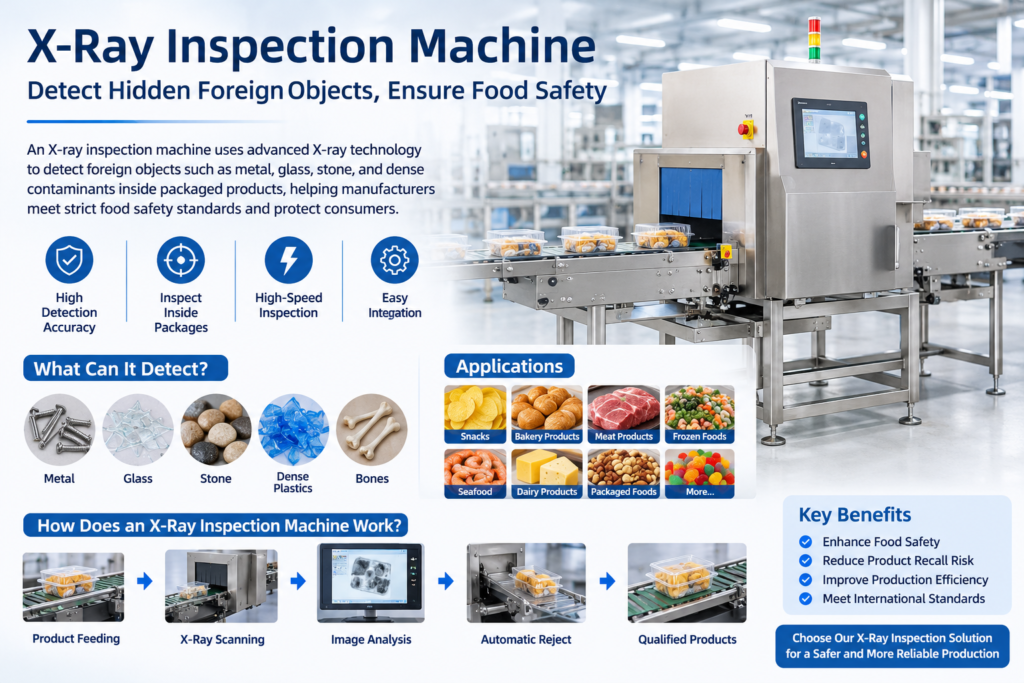
For food factories, a checkweigher can also be combined with other inspection equipment such as metal detectors and X-ray inspection systems.
What Should You Consider When Choosing an Automatic Checkweigher?
Different production lines have different requirements.
Before purchasing an automatic checkweigher, manufacturers should consider the following factors.
1. Product Dimensions
Provide the supplier with:
- Product length
- Product width
- Product height
- Product weight
These dimensions determine the appropriate conveyor and weighing configuration.
2. Product Type
The machine should be selected according to whether the product is:
- Solid
- Bagged
- Boxed
- Bottled
- Frozen
- Irregular-shaped
- Fragile
3. Weight Range
The machine needs to be suitable for the minimum and maximum product weights.
4. Production Speed
The required number of products per minute is an important factor.
Higher production speeds require appropriate conveyor design, product spacing, weighing technology, and rejection systems.
5. Reject Method
Different products require different rejection methods.
For example, an air-blow system may be suitable for lightweight products, while heavier products may require a mechanical pushing or separation system.
6. Production Line Layout
The checkweigher should match the height and direction of the existing conveyor.
The available factory space should also be considered.
7. Data and Quality Control Requirements
For factories with more advanced production management systems, checkweighers can potentially be integrated with production monitoring and data-management systems.
Automatic Checkweigher vs. Manual Weighing
| Feature | Manual Weighing | Automatic Checkweighing |
|---|---|---|
| Product handling | Manual | Automatic |
| Continuous inspection | Limited | Yes |
| Automatic rejection | No | Yes |
| Labor requirement | Higher | Lower |
| Production speed | Limited by operators | Designed for continuous production |
| Weight consistency | Operator dependent | System controlled |
| Production-line integration | Limited | Yes |
| Sorting capability | Manual | Automatic |
For low-volume production, manual weighing may still be practical.
For medium- and high-volume production, online checkweighing can provide a more automated approach to weight inspection.
Why Choose an Integrated Weighing and Rejecting Machine?
An automatic checkweigher with integrated rejection combines several processes into one system:
Conveying + Weighing + Weight Analysis + Rejection
This can simplify the production process and reduce the need for separate manual inspection stations.
For manufacturers upgrading an existing production line, the machine can also be configured according to the available conveyor height, product dimensions, production speed, and required reject method.
Huixin Automatic Checkweigher Solutions
Huixin Intelligent Technology Co., Ltd. provides automatic weighing and inspection equipment for manufacturers looking to improve production automation and quality control.
Our dynamic checkweighing solutions are designed for applications where products need to be weighed continuously during production.
Depending on the application, the equipment can be configured with:
- Automatic product conveying
- Dynamic weighing
- Weight classification
- Automatic reject system
- Adjustable weight parameters
- Different conveyor configurations
- Customized machine dimensions
- Integration with existing production lines
The equipment can be used for food, cosmetics, daily necessities, hardware, and other packaged products.
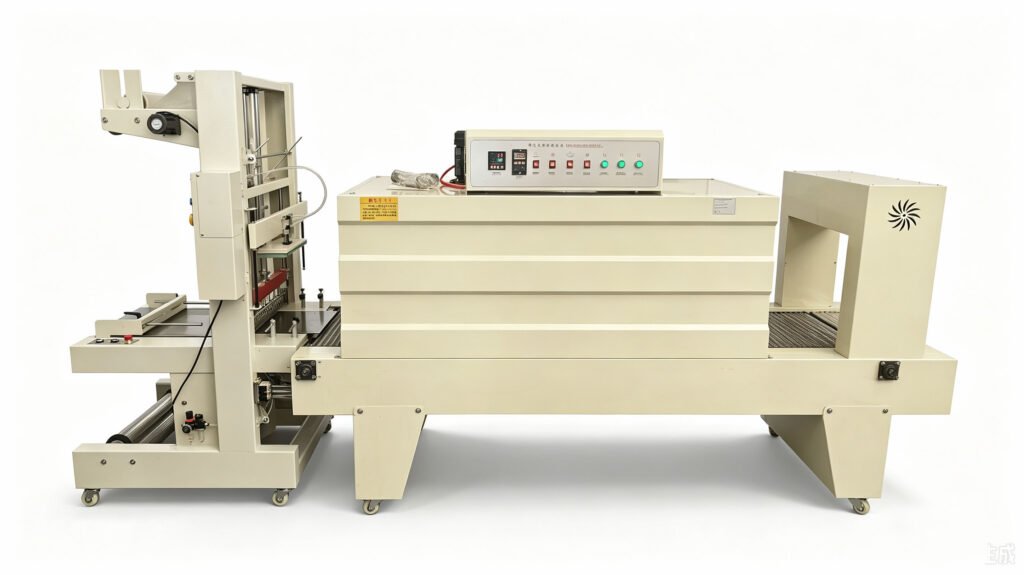
We also provide other food inspection and packaging equipment, including food metal detectors, X-ray inspection systems, packaging machines, and other production-line equipment.
From a standalone checkweigher to an integrated inspection and packaging line, our team can assist with equipment selection, customization, installation guidance, operator training, spare parts, and after-sales technical support.
Conclusion
An automatic checkweigher with reject system can turn weight inspection from a manual operation into a continuous production-line process.
By combining dynamic weighing, automatic analysis, and automatic rejection, manufacturers can improve weight control, reduce repetitive manual inspection, and create a more consistent production process.
The most suitable checkweigher should be selected according to the actual product, weight range, dimensions, production speed, rejection requirements, and existing production-line configuration.
For manufacturers planning to automate their weighing and sorting process, providing product samples, dimensions, weight range, production speed, and packaging information to the equipment supplier is a good starting point for machine selection.
Huixin Intelligent Technology provides customized automatic checkweighing and production-line solutions for manufacturers and distributors worldwide.